


Report
Report
OSCE Implementation Meeting - Tolerance and non-discrimination I, National minorities - Statement of Rainbow
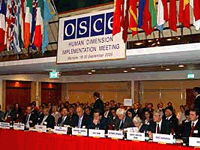 Thank you Mr Moderator.
My statement today will focus on the linguistic rights of the Macedonian speaking minority of Greece.
One of the basic demands of the Macedonian minority is to have the right to use traditional place names and have their first name and surname in their own language recognized by the state.
During the inter-war period between World War I and World War II, Greece enacted a number of laws which replaced all non-Greek names of towns, villages, rivers and mountains with Greek names. These traditional toponyms (which still exist in unofficial use among the population) are not given official recognition by the Greek state. This is not in accord with Recommendation number 3 of the High Commissioner's Oslo Recommendations regarding the Linguistic Rights of National Minorities.
Also during the inter-war period, during the 1920s and 1930s the personal names of the Macedonian speaking population were also forcibly changed. Macedonian personal names were replaced with Greek ones. Of the thousands of names that were changed, so too was the name of the Benishev family which became "Vasiliadis”.
Last year Mr Petros Vasiliadis, a member of this family made an application to the local Prefect in Florina/Lerin to change his surname back to the traditional Macedonian family name "Benishev”. The local Prefect and the Regional Administration rejected the application, both noting that the applicant does not have a right to such a surname because "there is no such thing as a Macedonian minority in Greece”.
It should be noted that Paragraph 32 of the Copenhagen document states that "To belong to a national minority is a matter of a person's individual choice and no disadvantage may arise from the exercise of such choice”. Therefore the action of the Greek State seems to be in violation of this paragraph as well as incompatible with Recommendation 1 of the High Commissioner's Oslo Recommendations.
Although various human rights bodies have strongly recommended the Greek state to take measures for the recognition and the protection of the rights of the Macedonian-speaking population in Greece, including the ratification of the European Charter of Regional or Minority Languages. However Greece has ignored such advice.
It is a common practice of Greek representatives in various international forums, to claim that there is no Macedonian minority but "a small number of people speaking a Slavic dialect or idiom in Northern Greece” referring to the Macedonian-speaking community. So the question must be asked: why has the Greek government not taken any measures to protect and promote the so-called "dialect”? I should mention that the so-called dialect or idiom that the Greek government refers to actually belongs to a language, the Macedonian language. In fact the language was recognized as "Macedonian” by the Greek government in the census of 1920 as a language separate to Serbian and Bulgarian.
Two years ago Macedonian minority activists reprinted a primer in the Macedonian language which was produced by the Greek government under pressure from the League of Nations in 1925. The activists felt it was necessary to take this measure because the Greek government had failed to take action in this regard. Letter after letter was sent to the Greek Ministry of Education in relation to the introduction of Macedonian language education, but there was never a response.
Despite the total ignorance of the Greek state in relation to the Macedonian minority, activists continue to push for the introduction of Macedonian language education in Greece. In this connection, this Rainbow, the Organisation of the Macedonian Minority in Greece has taken another step to assist the Greek government by publishing a bilingual Macedonian/Greek dictionary.
Since the Greek government has refused meetings on this issue, I would like to use this opportunity today to present the Greek delegation with a copy of this important project.
* At this point the representative of Rainbow presented the Greek delegation with a draft copy of the proposed bilingual dictionary